Spring 2016: Phl 220 – Existentialism

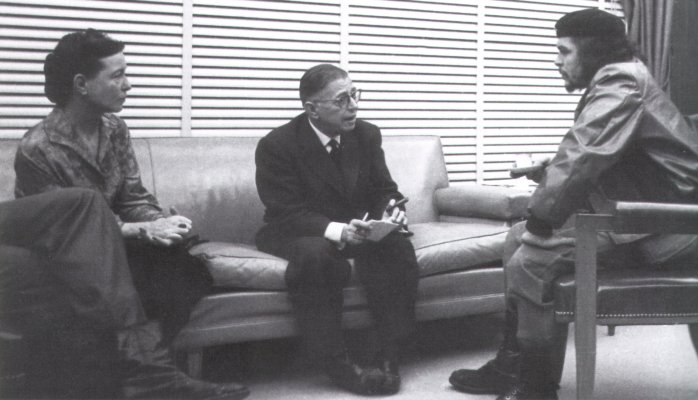
sartre che

General information

Instructor

Here is more information about Prof. Lotz

Class Meetings

Days: MW
Time: 12:40 PM – 2 PM
Place: A228 Wells Hall

Office

Phone: 517.355.4490 [dept.])
Place: 518 South Kedzie Hall
Hours: M 5-6pm, W 2:30-3pm, and by appointment

Other Contact

E-mail: lotz@msu.edu
Home Phone: please ask
Webpage: https://christianlotz.wordpress.com

Box

You will find my box in the front office of the philosophy department (SK 503)

Schedule

General Introduction (via Tillich)

Jan 11, General Introduction: Existentialism, Conscience, Faith

Jan 13, General Introduction: Existentialism, Conscience, Faith
Please read Tillich, The Courage to be, chapter 1, subsection 1+2

Jan 18,
no class
Prepare Tillich

Jan 20, Anxiety
The Courage to Be, chapter 2

Jan 25, Being Oneself
The Courage to Be, chapter 5

Jan 27, Faith
The Courage to Be, chapter 6

Faith and Action (Kierkegaard)

Feb 1, Abraham
Fear and Trembling, pp.1-26
[Snider, Kransz]

Feb 3, Anxiety and Passion
Fear and Trembling, pp.27-53
[de Vries, Chance]

Feb 8, The Religious Suspension of the Ethical
Fear and Trembling, pp.54-67
[Maddox]

Feb 10, Absolute Duty
Fear and Trembling, pp.68-81
[Alalouf, Shantz]

Conscience and Responsibility (Bonhoeffer)

Feb 15, Film
Bonhoeffer

Feb 17, The Individual and the Good, Intro Bonhoeffer
Ethics, pp.1-15 (Christ, Reality, and Good); pp. 25-38  (Ethics as Formation)

Feb 22, Concrete Ethics
Ethics, pp. 44-47 (Ethics as Formation); pp.145-153 and pp.158-166, History and Good [1]
[Scheuer, Staiger]

Feb 24, Responsibility
Ethics, pp.167-214, esp. pp.177-206, History and Good [2]
[Wiesner, Bonds]

Feb 29, Responsibility
Ethics, pp.167-214, esp. pp.177-206, History and Good [2]
[Green]

Mar 2, Film
Bonhoeffer

Mar 7
Spring Break

Mar 9
Spring Break

Freedom and Action (Sartre and Beauvoir)

Mar 14, Existence
Existentialism is a Humanism, pp. 17-54
[Reihanian, McBride]

Mar 16, Freedom and Others
Existentialism is a Humanism, pp. 17-54
[Schiff, Kowal]

Mar 21, Freedom
Ethics of Ambiguity, chapter 1
[Rall, Hawks]

Mar 23, Others
Ethics of Ambiguity, chapter 2
[Harris, Ostrowski]

Mar 28, Freedom and Liberation
Ethics of Ambiguity, chapter 3.1-3.3
[Bellingar, Abalo]

Mar 30, Action
Ethics of Ambiguity, chapter 3.1-3.3
[Cortese, Baltusis]

Apr 4, Film
Sartre and Beauvoir

Racial Oppression, Colonization, and Liberation (Sartre and Fanon)

Apr 6, Sartre and Fanon
Sartre, Materialism and Revolution (via email); Sartre, Preface to Fanon (via email)
[Johnson, Lee]

Apr 11, no class

Apr 13, Language
Sartre, Materialism and Revolution
Black Skin, White Masks, chapter 1
[Khan, Wagster]

Apr 18, The Colonized
Black Skin, White Masks, chapter 2-3
[Chard, Haberlein]
Final assignment passed out in class

Apr 20, The Colonized
Black Skin, White Masks, chapter 4-5
[Mensch]
[Falkowski]

Apr 25, Lived Experience
Black Skin, White Masks, chapter 5

Apr 27, Wrap up, Film
Concerning Violence

May 4, (day of final exam)
Final paper due by May 4 at 10:20am via D2L dropbox

Course Description

“Those who believe do not escape.”
(Bonhoeffer/Isaiah)

In this class we will discuss central aspects of Existentialism by focusing on faith, ethics, and social-political issues. We will try to uncover the strong connection between existentialist thought and Protestantism, which was very influential for the popularity of Existentialism during the 20th Century. We will not follow the “standard” Anglo-American view of Existentialism, i.e., we will not discuss Heidegger and Nietzsche. Check the Stanford Encyclopedia entry for an introduction to the general background of this class. One goal of this class is to demonstrate that resistance to subsuming the individual under some kind of “abstract” ethical or political regime is key to understanding existential thought.

Note

This is a 200-level course in philosophy and, as such, contains difficult material and requires mature students. If you are not willing to study dense written material, listen to unusual lectures, and discuss ideas in an organized fashion, then you should not take this class. This class though can be taken by students without prior knowledge in philosophy. You should not take this class if you are not an avid reader.

Course Goals

This lecture class should students introduce to

  • the origin of modern Existentialism in Protestantism
  • an existential concept of faith
  • the concept of ethical dilemmas
  • the conflict between morality and religion
  • existentialist conceptions of freedom, violence, and action
  • existentialism in a racialized world
  • basic concepts used by existentialists

Note

Students should be aware of the fact that this course is based on difficult texts. Accordingly, this class requires self-responsible learners and an intense confrontation with the primary text. Accordingly, if you are not excited about the prospect of a daily confrontation with abstract and historical reflections, then you should not take this class. This class is not based on a set of fixed knowledge and, as such, is not based on a behavioral idea of education; rather, we will try to learn together and critically examine the material. The instructor of this class does not have anything to teach, but much to learn.

Required Texts

No digital editions, please!

Course Requirements

  • daily reading and studying (around 5-10 pages, up to 50 per week)
  • 1 thesis statement (short assignment, systematic summary of the readings)
  • 1 final assignment
  • 5 response sheets
  • homework assignments and spontaneous assignments in class; unannounced reading quizzes
  • participation

Note

The class and my lectures are solely based on the texts selected for class and require a thorough study and preparation of the material. I will primarily lecture on the readings, which will help you to more fully understand the texts. Therefore it is not sufficient for students to come to class without having prepared the texts. And indeed, in the assignments you have to demonstrate whether you have appropriately prepared the readings selected for each lecture.

Note

Every academic misconduct, such as plagiarism, will – without exception – lead to a failing grade in class. Check the Ombudsman’s page (see also note below on plagiarism):  https://www.msu.edu/~ombud/

Attendance

To get a good grade in this class, regular attendance is required. I will not call roll. Hence, it is up to you to come to class or not.However, if you do not come to class on a regular basis and participate in the class discussion, it is impossible for you to achieve a good grade in this class; so coming to class is your responsibility and your call. If you choose to attend class, please come on time, turn off cell phones and other electronic devices that interfere with your (and others’) concentration, have the reading prepared and be ready to participate. If you are not prepared, do not bother showing up. It is a sign of disrespect to your peers and the instructor to attend class unprepared. If you miss class, it is your responsibility to obtain class notes from a fellow student and to catch up on reading. Nevertheless, please be aware that you should not make me responsible for a failure that results out of your decision. You should be aware that chances to master this class are minimal, if you do not show up for class or if you do not prepare the readings (=studying).

Assignments

Thesis Statement (brief overview of assigned reading)

Each student has to prepare one thesis statement for class. The thesis statement should contain [a] a list of main points and claims, [b] concepts that are unclear, [c] intelligent questions about the readings. Students who prepare the thesis paper need to send their thesis papers by 6pm (the day before class) per email to me, bring copies for everyone to class and be prepared to briefly present their statement (this will rarely happen). The thesis statement is limited to one page and you must use the following prepared document:

Download thesis statement form

Reading Quizzes

Given recent negative experience with student’s unwillingness to read and study primary material, I might assign reading quizzes. Questions might be passed out in advance. Quizzes cannot be made up (except in cases mentioned below).

Homework Assignments

From time to time I will send out via email weekend homework assignments; usually a short writing prompt in relation to either lecture or video material online, or in relation to our readings. Given that these homework assignments are always due on Mondays, I will not accept late turn-ins. There is plenty of time for you to respond to the task, given that I usually send this out on time.

Unannounced Assignments

There might be – from time to time – spontaneously assigned group assignments in class. Students who do not attend class (and have no medical documentation) will lose all points.

Response Sheets

Every student is asked to submit up to 5 class response sheets during the semester. Please download the form here (plus: print it out five times and add it to your class folder). Response sheets must be submitted at the end of a class session. I do not accept late turn ins or turn ins by email.

Download response sheet (I will only accept answers that are given on this form)

Note

Students are not allowed to turn in response sheets during the last week of class!

Make-Up Assignments

Students who need to miss assignments for excusable reasons, such as a death in their families, MSU related business, emergency weather conditions, or medical reasons, must inform me ahead of time, and will be permitted to make up assignments. I will only accept official doctor notes (no faxes, no emails) or letters from other professors. Unfortunately I am unable to accept any other reasons than those mentioned.

Course Evaluation

Assignments

1 final take-home assignment 20 points
Reading quizzes 10 points
Homework assignments and
unannounced group assignments
25 points
1 thesis statement (use form) 10 points
participation 10 points
response sheets (use form) 25 points
——–
100 points

Grading

4.0 (=A) 100 – 93
3.5 92 – 87
3 (=B) 86 – 82
2.5 81 – 77
2 (=C) 76 – 72
1.5 71 – 65
1.0 (=D) 64 – 60
0.0 < 60

GENERIC SYLLABUS (might not be applicable to each class)

Laptop/Cell Phone/Tablet Policy

You are not permitted to use laptops or cell phones in class, unless needed for medical reasons. Flat devices, such as tablets, are permitted if you have purchased the literature required for class electronically. Please do not text under the table. Cell phones should be removed from tables. Failure to follow this policy will lead to unannounced assignments in class or loss of points (at the digression of the instructor).

Class Attendance

As mentioned above, I do not employ in my classes a class attendance policy. Having said this, you should be aware that class attendance is very important. When engaging in a philosophical and humanistic dialogue it is necessary to be an active and present participant in the ongoing discussion. If you miss class please do not email me asking if you missed anything important. Every class is important. You should get a study buddy for the class; a student in class who will inform you of what you missed. If you miss a class you can come to my office hours or make an appointment to discuss the material, providing you have read the material and you simply want to see if your understanding of the material is on target. Time in office hours will not be used to repeat the class lectures.

Grading Criteria + Paper Writing Tips

Check out this page for grading criteria, example of assignments, etc.

Online Research Sources

Unfortunately, some people think that the internet as such is a reliable source of information. If you decide to use online sources for additional information or your paper then do not just use one of the common internet search engines, such as Google; rather, use reliable academic sources, such as Britannica Online, or the Stanford Encyclopedia of Philosophy. The Internet Ecyclopedia of Philosophy isn’t very good, but still acceptable. Check out MSU’s library resources! And, as with other sources, you must cite any online sources to which you refer in your essay.

Writing Center Information

MSU’s writing center offers excellent help on all matters regarding writing and learning. Check the website at http://writing.msu.edu for an overview and hours. For more information, please call 517.432.3610 or send an e-mail to writing@msu.edu.

Grief Absence Policy

I follow MSU’s general grief absence policy, which can be found here.

Integrity of Scholarship and Grades (Plagiarism)

The following statement of University policy addresses principles and procedures to be used in instances of academic dishonesty, violations of professional standards, and falsification of academic or admission records, herein after referred to as academic misconduct. [See General Student Regulation 1.00, Protection of Scholarship and Grades.]

Academic Honesty

Article 2.3.3 of the Academic Freedom Report states that “The student shares with the faculty the responsibility for maintaining the integrity of scholarship, grades, and professional standards.” In addition, the (insert name of unit offering course) adheres to the policies on academic honesty as specified in General Student Regulations 1.0, Protection of Scholarship and Grades; the all-University Policy on Integrity of Scholarship and Grades; and Ordinance 17.00, Examinations. (See Spartan Life: Student Handbook and Resource Guide and/or the MSU Web site: www.msu.edu) Therefore, unless authorized by your instructor, you are expected to complete all course assignments, including homework, lab work, quizzes, tests and exams, without assistance from any source. You are expected to develop original work for this course; therefore, you may not submit course work completed for another course to satisfy the requirements for this course. Students who violate MSU rules may receive a penalty grade, including but not limited to a failing grade on the assignment or in the course. Contact your instructor if you are unsure about the appropriateness of your course work. (See also https://www.msu.edu/~ombud/)

Plagiarism, from the Ombudsman’s page

Plagiarism (from the Latin plagiarius, an abductor, and plagiare, to steal) is defined by the White House Office of Science and Technology Policy on Misconduct in Research (take that!) as “ . . . the appropriation of another person’s ideas, processes, results or words without giving appropriate credit.”

Accidental or Unintentional
One may not even know that they are plagiarizing.  It is the student’s responsibility to make certain that they understand the difference between quoting and paraphrasing, as well as the proper way to cite material.

Blatant
Here, students are well aware that they are plagiarizing.  Purposefully using someone else’s ideas or work without proper acknowledgment is plagiarism.  This includes turning in borrowed or bought research papers as one’s own.

Self
Turning in the same term paper (or substantially the same paper) for two courses without getting permission from one’s instructor is plagiarism.

SIRS Evaluations

Michigan State University takes seriously the opinion of students in the evaluation of the effectiveness of instruction and has implemented the Student Instructional Rating System (SIRS) to gather student feedback (https://sirsonline.msu.edu). This course utilizes the online SIRS system, and you will receive an e-mail during the last two weeks of class asking you to fill out the SIRS web form at your convenience. In addition, participation in the online SIRS system involves grade sequestration, which means that the final grade for this course will not be accessible on STUINFO during the week following the submission of grades for this course unless the SIRS online form has been completed. Alternatively, you have the option on the SIRS website to decline to participate in the evaluation of the course. We hope, however, that you will be willing to give us your frank and constructive feedback so that we may instruct students even better in the future. If you access the online SIRS website and complete the online SIRS form or decline to participate, you will receive the final grade in this course as usual once final grades are submitted.

Social Media and Sharing of Course Materials

As members of a learning community, students are expected to respect the intellectual property of course instructors. All course materials presented to students are the copyrighted property of the course instructor and are subject to the following conditions of use:

  1. Students may record lectures or any other classroom activities and use the recordings only for their own course-related purposes.
  2. Students may share the recordings with other students enrolled in the class. Sharing is limited to using the recordings only for their own course-related purposes.
  3. Students may post the recordings or other course materials online or distribute them to anyone not enrolled in the class with the advance written permission of the course instructor and, if applicable, any students whose voice or image is included in the recordings.
  4. Any student violating the conditions described above may face academic disciplinary sanctions.

Accommodations for Students with Disabilities

Students with disabilities should contact the Resource Center for Persons with Disabilities to establish reasonable accommodations. For an appointment with a counselor, call 353-9642 (voice) or 355-1293 (TTY)

Drops and Adds

The last day to add this course is the end of the first week of classes. The last day to drop this course with a 100 percent refund and no grade reported is (see Academic Calendar). The last day to drop this course with no refund and no grade reported is (see Academic Calendar). You should immediately make a copy of your amended schedule to verify you have added or dropped this course.

Note on Attendance

Students who fail to attend the first four class sessions or class by the fifth day of the semester, whichever occurs first, may be dropped from the course.

.

Spring 2016: Phl 357 – Karl Marx

marx_engels_nrz

General information

Instructor

Here is more information about Prof. Lotz

Class Meetings

Days: MW
Time: 10:20 AM – 11:40 AM
Place: 120 Berkey Hall

Office

Phone: 517.355.4490 [dept.])
Place: 518 South Kedzie Hall
Hours: M 5-6pm, W 2:30-3pm, and by appointment

Other Contact

E-mail: lotz@msu.edu
Home Phone: please ask
Webpage: https://christianlotz.wordpress.com

Box

You will find my box in the front office of the philosophy department (SK 503)

Schedule

Introduction

Jan 11, Introduction

Jan 13, Feuerbach Thesis 11

Jan 18,
no class

Jan 20, Marx to Ruge, May 1843 (online), Marx to Ruge, September 1843 (online); Towards a Critique of Hegel’s Philosophy of Right, 71-82
please read these excerpts, and bring them to class

Labor

Jan 25, Feuerbach Theses, 171-174

Jan 27, Economic and Philosophical Manuscripts, 83-95
[Greene]

Feb 1, Economic and Philosophical Manuscripts, 83-95
[Nebergall]

Feb 3, Economic and Philosophical Manuscripts, 95-104
[Worden]

Materialism

Feb 8, German Ideology, 175-184; Letter to Annenkov, 209-211
[Collins, Delange]

Feb 10,  German Ideology, 184-198
[Kulesza]

Feb 15, German Ideology, 184-198; Letter to Sassoulitch, 623-629
[Evert]

Politics

Feb 17, Communist Manifesto, 245-273
{Countryman, Bredehoft}

Feb 22, Communist Manifesto, 245-273
(Countryman, Bredehoft)

Feb 24, Critique of the Gotha Program, 609-616; Free Individuals in Communist Societies, 207-208; Artistic Talent under Communism, 205-206
[Metaj, Dillon]

Feb 29, Civil War in France (on Paris Commune), 584-603; On Bakunin, 606-610
[Miller]

Dialectics

Mar 2, Grundrisse, introduction, 380-395
[Buchanan]

Mar 7
Spring Break

Mar 9
Spring Break

Mar 14, Grundrisse, introduction, 380-395
[Sun]

Reading Capital: Value and Commodity Form

Mar 16, Capital, ch.1.1-1.3
[Thornton, Carpenter]

Mar 21, Capital, ch.1.4
[Rossow, Remenec]

Mar 23, Capital, ch.1.4
[Shi, DuBois]

Reading Capital: Money and Capital

Mar 28, Capital, ch.2
[Harig]

Mar 30, Capital, ch.4
[Williams]

Apr 4, Capital, ch.4+5
[Li]

Apr 6, Capital, ch.5+6
[Talber]

Apr 11, canceled

Reading Capital: Surplus Value

Apr 13, Capital, section 10 of chapter 15
Guest Lecture, Prof. Brett Clark (University of Utah)

April 16, Workshop, Towards a Red and Green Future? Marxism, Critical Theory, and Environmental Philosophy

Apr 18, Capital, ch.6+7
Final assignment passed out in class
[Steele]
[Pace]

Apr 20, Capital, ch.7+8
[Janisch]

Reading Capital: Primitive Accumulation

Apr 25, Capital, ch.26-32
[Chapman]

Apr 27
Wrap Up

May 4, (day of final exam)
Final paper due by May 4 at 10:20am via D2L dropbox

Course Description

kapital_lesen_01In this class we will discuss central aspects of Marx’s philosophy and social theory. We will focus on his conception of society and the role of labor, on a few political aspects of his philosophy, as well as on his first larger economic work, Capital, which still is a fascinating, but very difficult book. We will not extensively deal with Marx’s political theory (revolution, party conception, labor movement, etc.). We will exclusively deal with primary texts and exclude broader historical questions, such as the development of socialist philosophies in the 19th Century, or 20th Century developments within the great tradition of Marxism. As such, this course presents Marx as a systematic thinker who wants to be studied again and should not be reduced to a historical figure.

This site is a great resource: www.marxists.org

Note

This is a 300-level course in philosophy and, as such, contains difficult material and requires mature students. If you are not willing to study dense written material, listen to unusual lectures, and discuss ideas in an organized fashion, then you should not take this class. This class though can be taken by students without prior knowledge in philosophy. You should not take this class if you are not an avid reader.

Course Goals

This lecture class should students introduce to

  • the concept of labor as the central concept for social-political philosophy
  • how to think about the relation between labor and society
  • the materialist conception of history
  • a few selected political ideas in Marx (though we will not focus on politics)
  • basic concepts of Marx’s Capital, such as social categories, money, capital, technology, and labor power

Note

marxsunglassesStudents should be aware of the fact that this course is based on difficult texts. Accordingly, this class requires self-responsible learners and an intense confrontation with the primary text. Accordingly, if you are not excited about the prospect of a daily confrontation with abstract and historical reflections, then you should not take this class. This class is not based on a set of fixed knowledge and, as such, is not based on a behavioral idea of education; rather, we will try to learn together and critically examine the material. The instructor of this class does not have anything to teach, but much to learn.

Required Texts

  • McLellan, Karl Marx Selected Writings, Oxford University Press; please get the 2nd edition
  • Marx, Capital, Vol 1, (Penguin Classics)

No digital editions, please!

Course Requirements

  • daily reading and studying (around 5-10 pages, up to 50 per week)
  • reading quizzes
  • 1 thesis statement (short assignment, systematic summary of the readings)
  • 1 final assignment
  • 5 response sheets
  • homework assignments and spontaneous assignments in class
  • participation

Note

The class and my lectures are solely based on the texts selected for class and require a thorough study and preparation of the material. I will primarily lecture on the readings, which will help you to more fully understand the texts. Therefore it is not sufficient for students to come to class without having prepared the texts. And indeed, in the assignments you have to demonstrate whether you have appropriately prepared the readings selected for each lecture.

Note

Every academic misconduct, such as plagiarism, will – without exception – lead to a failing grade in class. Check the Ombudsman’s page (see also note below on plagiarism):  https://www.msu.edu/~ombud/

Assignments

Make-Up Assignments

Students who need to miss assignments for excusable reasons, such as a death in their families, MSU related business, emergency weather conditions, or medical reasons, must inform me ahead of time, and will be permitted to make up assignments. I will only accept official doctor notes (no faxes, no emails) or letters from other professors. Unfortunately I am unable to accept any other reasons than those mentioned.

Attendance

To get a good grade in this class, regular attendance is required. I will not call roll. Hence, it is up to you to come to class or not.However, if you do not come to class on a regular basis and participate in the class discussion, it is impossible for you to achieve a good grade in this class; so coming to class is your responsibility and your call. If you choose to attend class, please come on time, turn off cell phones and other electronic devices that interfere with your (and others’) concentration, have the reading prepared and be ready to participate. If you are not prepared, do not bother showing up. It is a sign of disrespect to your peers and the instructor to attend class unprepared. If you miss class, it is your responsibility to obtain class notes from a fellow student and to catch up on reading. Nevertheless, please be aware that you should not make me responsible for a failure that results out of your decision. You should be aware that chances to master this class are minimal, if you do not show up for class or if you do not prepare the readings (=studying).

Thesis Statement (brief overview of assigned reading)

Each student has to prepare one thesis statement for class. The thesis statement should contain [a] a list of main points and claims, [b] concepts that are unclear, [c] intelligent questions about the readings. Students who prepare the thesis paper need to send their thesis papers by 6pm (the day before class) per email to me, bring copies for everyone to class and be prepared to briefly present their statement (this will not always happen). The thesis statement is limited to one page and you must use the following prepared document:

Download thesis statement form

Reading Quizzes

Given recent negative experience with student’s unwillingness to read and study primary material, I might assign reading quizzes. Questions will be passed out in advance. Quizzes cannot be made up (except in cases mentioned above).

Homework Assignments

From time to time I will send out via email weekend homework assignments; usually a short writing prompt in relation to either lecture or video material online, or in relation to our readings. Given that these homework assignments are always due on Mondays, I will not accept late turn-ins. There is plenty of time for you to respond to the task, given that I usually send this out on time.

Unannounced Assignments

There might be – from time to time – spontaneously assigned group assignments in class. Students who do not attend class (and have no medical documentation) will lose all points.

Response Sheets

Every student is asked to submit up to 5 class response sheets during the semester. Please download the form here (plus: print it out five times and add it to your class folder). Response sheets must be submitted at the end of a class session. I do not accept late turn ins or turn ins by email.

Download response sheet (I will only accept answers that are given on this form)

Note

Students are not allowed to turn in response sheets during the last week of class!

Course Evaluation

Assignments

1 final assignment 20 points
Reading quizzes 10 points
Homework assignments and
unannounced group assignments
25 points
1 thesis statement (use form) 10 points
participation 10 points
response sheets (use form) 25 points
——–
100 points

Grading

4.0 (=A) 100 – 93
3.5 92 – 87
3 (=B) 86 – 82
2.5 81 – 77
2 (=C) 76 – 72
1.5 71 – 65
1.0 (=D) 64 – 60
0.0 < 60

GENERIC SYLLABUS (might not be applicable to each class)

Laptop/Cell Phone/Tablet Policy

You are not permitted to use laptops or cell phones in class, unless needed for medical reasons. Flat devices, such as tablets, are permitted if you have purchased the literature required for class electronically. Please do not text under the table. Cell phones should be removed from tables. Failure to follow this policy will lead to unannounced assignments in class or loss of points (at the digression of the instructor).

Class Attendance

As mentioned above, I do not employ in my classes a class attendance policy. Having said this, you should be aware that class attendance is very important. When engaging in a philosophical and humanistic dialogue it is necessary to be an active and present participant in the ongoing discussion. If you miss class please do not email me asking if you missed anything important. Every class is important. You should get a study buddy for the class; a student in class who will inform you of what you missed. If you miss a class you can come to my office hours or make an appointment to discuss the material, providing you have read the material and you simply want to see if your understanding of the material is on target. Time in office hours will not be used to repeat the class lectures.

Grading Criteria + Paper Writing Tips

Check out this page for grading criteria, example of assignments, etc.

Online Research Sources

Unfortunately, some people think that the internet as such is a reliable source of information. If you decide to use online sources for additional information or your paper then do not just use one of the common internet search engines, such as Google; rather, use reliable academic sources, such as Britannica Online, or the Stanford Encyclopedia of Philosophy. The Internet Ecyclopedia of Philosophy isn’t very good, but still acceptable. Check out MSU’s library resources! And, as with other sources, you must cite any online sources to which you refer in your essay.

Writing Center Information

MSU’s writing center offers excellent help on all matters regarding writing and learning. Check the website at http://writing.msu.edu for an overview and hours. For more information, please call 517.432.3610 or send an e-mail to writing@msu.edu.

Grief Absence Policy

I follow MSU’s general grief absence policy, which can be found here.

Integrity of Scholarship and Grades (Plagiarism)

The following statement of University policy addresses principles and procedures to be used in instances of academic dishonesty, violations of professional standards, and falsification of academic or admission records, herein after referred to as academic misconduct. [See General Student Regulation 1.00, Protection of Scholarship and Grades.]

Academic Honesty

Article 2.3.3 of the Academic Freedom Report states that “The student shares with the faculty the responsibility for maintaining the integrity of scholarship, grades, and professional standards.” In addition, the (insert name of unit offering course) adheres to the policies on academic honesty as specified in General Student Regulations 1.0, Protection of Scholarship and Grades; the all-University Policy on Integrity of Scholarship and Grades; and Ordinance 17.00, Examinations. (See Spartan Life: Student Handbook and Resource Guide and/or the MSU Web site: www.msu.edu) Therefore, unless authorized by your instructor, you are expected to complete all course assignments, including homework, lab work, quizzes, tests and exams, without assistance from any source. You are expected to develop original work for this course; therefore, you may not submit course work completed for another course to satisfy the requirements for this course. Students who violate MSU rules may receive a penalty grade, including but not limited to a failing grade on the assignment or in the course. Contact your instructor if you are unsure about the appropriateness of your course work. (See also https://www.msu.edu/~ombud/)

Plagiarism, from the Ombudsman’s page

Plagiarism (from the Latin plagiarius, an abductor, and plagiare, to steal) is defined by the White House Office of Science and Technology Policy on Misconduct in Research (take that!) as “ . . . the appropriation of another person’s ideas, processes, results or words without giving appropriate credit.”

Accidental or Unintentional
One may not even know that they are plagiarizing.  It is the student’s responsibility to make certain that they understand the difference between quoting and paraphrasing, as well as the proper way to cite material.

Blatant
Here, students are well aware that they are plagiarizing.  Purposefully using someone else’s ideas or work without proper acknowledgment is plagiarism.  This includes turning in borrowed or bought research papers as one’s own.

Self
Turning in the same term paper (or substantially the same paper) for two courses without getting permission from one’s instructor is plagiarism.

SIRS Evaluations

Michigan State University takes seriously the opinion of students in the evaluation of the effectiveness of instruction and has implemented the Student Instructional Rating System (SIRS) to gather student feedback (https://sirsonline.msu.edu). This course utilizes the online SIRS system, and you will receive an e-mail during the last two weeks of class asking you to fill out the SIRS web form at your convenience. In addition, participation in the online SIRS system involves grade sequestration, which means that the final grade for this course will not be accessible on STUINFO during the week following the submission of grades for this course unless the SIRS online form has been completed. Alternatively, you have the option on the SIRS website to decline to participate in the evaluation of the course. We hope, however, that you will be willing to give us your frank and constructive feedback so that we may instruct students even better in the future. If you access the online SIRS website and complete the online SIRS form or decline to participate, you will receive the final grade in this course as usual once final grades are submitted.

Social Media and Sharing of Course Materials

As members of a learning community, students are expected to respect the intellectual property of course instructors. All course materials presented to students are the copyrighted property of the course instructor and are subject to the following conditions of use:

  1. Students may record lectures or any other classroom activities and use the recordings only for their own course-related purposes.
  2. Students may share the recordings with other students enrolled in the class. Sharing is limited to using the recordings only for their own course-related purposes.
  3. Students may post the recordings or other course materials online or distribute them to anyone not enrolled in the class with the advance written permission of the course instructor and, if applicable, any students whose voice or image is included in the recordings.
  4. Any student violating the conditions described above may face academic disciplinary sanctions.

Accommodations for Students with Disabilities

Students with disabilities should contact the Resource Center for Persons with Disabilities to establish reasonable accommodations. For an appointment with a counselor, call 353-9642 (voice) or 355-1293 (TTY)

Drops and Adds

The last day to add this course is the end of the first week of classes. The last day to drop this course with a 100 percent refund and no grade reported is (see Academic Calendar). The last day to drop this course with no refund and no grade reported is (see Academic Calendar). You should immediately make a copy of your amended schedule to verify you have added or dropped this course.

Note on Attendance

Students who fail to attend the first four class sessions or class by the fifth day of the semester, whichever occurs first, may be dropped from the course.

.

Fall 2015: Iah 231b – Capitalism and Globalization

enjoycapitalism

General information

Instructor

Here is more information about Prof. Lotz

Class Meetings

Days: M/W
Time: 3:00 PM – 4:50 PM
Place: 008 Ag Hall

Office

Hours: M/W, 5-5:30pm after class, and by appointment (office or skype)
Phone: 517.355.4490 [dept.])
Place: 518 S. Kedzie Hall

Other Contact

E-mail: lotz@msu.edu
Home Phone: please ask
Webpage: https://christianlotz.wordpress.com

Box

You will find my box in the front office of the philosophy department

Schedule

Introduction: Acceleration, Capital, Globalization

Sep 2, General Introduction

Sep 7,
Holiday – university closed

Sep 9, Capitalism and Global Acceleration
Marx/Engels, The Communist Manifesto, read section I+II [online here]
Pope Francis, Encyclical on Capitalism and Inequality, read chapter 2, section 1 [online here], also check this encyclical on the environment, and this NYT article on the pope and global capitalism

Sep 14, Capitalism and Global Acceleration
Marx/Engels, The Communist Manifesto, read section I+II [online here]
Bauman, Time and Class [via pdf]

Sep 16, Capitalism as Culture, Production of Needs
Robbins, Culture of Capitalism, chapter 1 (constructing the consumer)
also check this article in Jacobin on childhood

Sep 21, Society as Black Box, Capital, Money, Debt
Robbins, A primer on money, pp 1-12

Globalization and the Culture of Capitalism

Sep 23, Labor
Robbins, Culture of Capitalism, chapter 2

Sep 28, Labor
Robbins, Culture of Capitalism, chapter 2

Sep 30,  Labor
Robbins, Culture of Capitalism, chapter 2
Documentary

Oct 5, State
Robbins, Culture of Capitalism, chapter 4
For an example of “manufacturing consent” check this article and the bill proposed

Oct. 7,  State
Robbins, Culture of Capitalism, chapter 4
Documentary

Oct. 12
No class

Oct 14, Population Growth
Robbins, Culture of Capitalism, chapter 5

Oct 19,  Population Growth
Robbins, Culture of Capitalism, chapter 5

Oct 21, Poverty
Robbins, Culture of Capitalism, chapter 6

Oct 26, Poverty
Robbins, Culture of Capitalism, chapter 6
Documentary

Oct 28, Environment and Energy, Monsanto
Robbins, Culture of Capitalism, chapter 7

Nov 2, Environment and Energy, Seeds+Valorization of Life
Robbins, Culture of Capitalism, chapter 7
Read http://vandanashiva.com/?p=260
Video lecture by Shiva

The Contradictions of Capitalism

Nov 4,  Use Value vs. Exchange Value
Harvey, 17 Contradictions, Prologue+Introduction+ chapters 1; 2
Video lecture by Harvey

Nov 9, Capital vs. Labor
Harvey, 17 Contradictions, chapters 4; 5; 6
Check this article on low wage jobs

Nov 11, Competition vs. Centralization
Harvey, 17 Contradictions, chapters 8; 10

Nov 16, Equality vs. Classes
Harvey, 17 Contradictions, chapters 11; 14; 15

Thinking Differently

Nov 18, Economic Democracy
David Schweickart, Tired of Capitalism? How About Something Better? (via pdf)
Documentary

Nov 23, tbd
Guest Lecture by Prof. Gifford

Nov 25, no class

Nov 30, Plenitude and Sharing Economy
Juliette Schorr, Debating the Sharing Economy (available here)

Dec 2, Plenitude and Sharing Economy
Juliette Schorr, Debating the Sharing Economy (available here)

Dec. 7, Degrowth and Post-Growth Society
Paech, Liberation from Excess (pdf download here)
Check The Great Transition Project, read the entries by Foster, Kallis, and Daly;
also: Kallis’ response to Foster: here; Kallis on degrowth in The Internationalist

Dec 9, Economic Democracy
Read The Next System Project – general website of the project is here

Final Exam

Dec 17
Final take-home exam due by 3pm (day of final exam), submission via Dropbox

Course Description

“Capitalism does not need future, except as burning fuel”
(Heiner Müller)

In this class, we will critically explore our social environment by critically investigating the nature of capitalism, capitalistic culture, and its global consequences. We will first discuss general problems and issues of a process of globalization driven by capitalism; we will then deal with a fundamental reconstruction of what globalization is from a Marxist point of view. Finally, we will discuss alternatives and resistance to globalization. The challenging texts selected for this class will be accompanied by several high quality documentary films and paper assignments related to these films. Be aware that this class will be challenging, especially if you think that reading and self-responsible studying are things of the past, if you tend to make quick judgments, if fox news or msnbc are your primary news sources, or if you tend to confuse university education with professional education.

IAH Course Goals

Integrative Studies in the Arts and Humanities at MSU seeks to assist students to become more familiar with ways of knowing in the arts and humanities and to be more knowledgeable and capable in a range of intellectual and expressive abilities. IAH courses encourage students to engage critically with their own society, history, and culture(s); they also encourage students to learn more about the history and culture of other societies. They focus on key ideas and issues in human experience; encourage appreciation of the roles of knowledge and values in shaping and understanding human behavior; emphasize the responsibilities and opportunities of democratic citizenship; highlight the value of the creative arts of literature, theater, music, and arts; and alert us to important issues that occur among peoples in an increasingly interconnected, interdependent world.

IAH Course Goals Addressed in this Course

  • engage students critically with their own society, history, and culture(s)
  • encourage students to learn more about the history and culture of other societies
  • emphasize the responsibilities and opportunities of democratic citizenship

Specific Course Goals

This lecture class should students introduce to

  • critical analysis of society and our social environment
  • globalization as a process of capital
  • problems that this process produces (poverty, environment, gender, inequality, military, state monopoly, oligarchy)
  • a theoretical outlook on capitalism and globalization, especially on the fundamental role of money
  • the failures of capitalist society
  • the inner contradictions of our social system

Note

Real learning is not properly measured by multiple-choice tests; especially since in the humanities there is no specific content of a sort that may be covered well in standardized examinations, which every student in the humanities should be expected to master. Instead, you will – hopefully – come to recognize that this class is about a general intellectual reflection on our contemporary world that requires concepts and critical reflections. The class deals with your dignity as human beings and with your intellect and reason, which is best expressed in a form of learning that is based on understanding and insight, and not mere learning by heart. It is hoped that the class will stimulate the view that intellectual activity (and therefore human reality) has to do with the passion of thinking, and the passion of understanding of our world. Intense confrontation with texts is the center of this class. Information is important but secondary.

Required Texts (Bookstore)

Please buy the following titles.

  • Robbins, Global Problems and the Culture of Capitalism, latest edition
  • Harvey, 17 Contradictions of Capitalism, Oxford University Press

Texts per email (pdf)

  • tbd during the course

Course Organization

The course will be organized such that, ideally, each class period will include [i] “interactive” lecture, [ii] discussion time or [iii] response time. Students will be asked to intensively prepare a certain text or part of a text for the next class period.

Course Requirements

  • Daily reading and studying (around 50 pages per week)
  • 5 response sheets
  • final take-home exam
  • short film reaction papers
  • unannounced assignments in class, including reading quizzes

Note

The class and my lectures are solely based on the texts selected for class and require a thorough study and preparation of the material. I will primarily lecture on the readings, which will help you to more fully understand the texts. Therefore it is not sufficient for students to come to class without having prepared the texts. And indeed, in the exams you have to demonstrate whether you have appropriately prepared the readings selected for each lecture.

Note

Every academic misconduct, such as plagiarism, will – without exception – lead to a failing grade in class. Check the Ombudsman’s page (see also note below on plagiarism): https://www.msu.edu/~ombud/

Make-Up Assignments

Students who need to miss the exam or the movie for excusable reasons (medical+MSU related business) must inform me ahead of time, and will be permitted to make up the exam and movie assignment. I will only accept written documentation.

Note on Attendance

I hope and strongly encourage that students attend all lectures. However, I will not require attendance, as I think that college students should manage their own class attendance decisions. I will not call roll. Hence, it is up to you to come to class or not. However, if you do not come to class on a regular basis and participate in class, it is very difficult for you to achieve a good grade in this class, especially since you won’t be able to make up assignments in class. If you choose to attend class, please come on time, turn off cell phones and other electronic devices that interfere with your (and others’) concentration, have the reading prepared and be ready to participate. If you are not prepared, do not bother showing up. It is a sign of disrespect to your peers and the instructor to attend class unprepared. If you miss class, it is your responsibility to obtain class notes from a fellow student and to catch up on reading.

Unannounced Assignments

There will be announced and unannounced reading quizzes, homework-assignments, and group assignments. Students who do not attend class (and have no written documentation) will lose all points. Reading quizzes, homework assignments, and group assignments cannot be made up without reasonable excuses (see above).

Class Response Sheets

Every student is asked to submit up to 5 class response sheets during the semester. Please download the form here (plus: print it out five times and add it to your class folder). Response sheets must be submitted at the end of a class session. I do not accept late turn ins or turn ins by email.

Download response sheet (I will only accept answers that are given on this form)

Note

Students are not allowed to turn in response sheets during the last week of class!

Response Time

Selected response sheets will be addressed at the beginning of each class. This procedure will help you and me to clarify problems, reflect on topics, and to find answers to questions that came up during the lecture.

Film Response Papers

Up to five selected documentary films shown in class will be accompanied by short writing assignments (550-650 words). I will let you know at the end of a “film day” whether it will indeed be accompanied by an assignment. The documentary film selected for this class are all high quality films that will demand your attention and challenge your critical judgment. The assignment will be passed out in class. These assignments cannot be made up, unless you show medical documentation. Accordingly, if you do not come to class on “film days,” then you might lose the points for the assignment. Film assignments will be submitted via D2L dropbox.

Final Assignment

There will be a final take-home essay assignment passed out on the last day of class. It is due on the day of the final exam via D2L dropbox.

General Note

I expect that you come to class having prepared the texts carefully and thoroughly. The reading for the next session, if not clear from the course schedule (below), will be announced at the end of the previous class. “Preparing for class” implies underlining and making excerpts from the text assigned; looking up unfamiliar vocabulary and writing them into a note book (I encourage you to keep a vocabulary booklet for all of your classes). Just reading the text won’t be sufficient. You have to study the material. Some vocabulary might not be sufficiently explained in a regular dictionary (this goes especially for philosophical terms), so it is necessary to consult additional sources, and the MSU Library Website is a great resource for nearly all questions in this regard).

Course Evaluation

Assignments

1 final take-home exam 20 points
5 film reaction papers (up to 600 words) 30 points
unannounced reading quizzes, homework assignments, and group assignments 25 points
5 response sheets (use form) 25 points
——–
100 points

Grading

4.0 (=A) 100 – 93
3.5 92 – 87
3 (=B) 86 – 82
2.5 81 – 77
2 (=C) 76 – 72
1.5 71 – 65
1.0 (=D) 64 – 60
0.0 < 60

GENERIC SYLLABUS (might not be applicable to each class)

Laptop/Cell Phone/Tablet Policy

You are not permitted to use laptops or cell phones in class, unless needed for medical reasons. Flat devices, such as tablets, are permitted  if you have purchased the literature required for class electronically. Please do not text under the table. Cell phones should be removed from tables. Failure to follow this policy will lead to unannounced assignments in class or loss of points (at the digression of the instructor).

Class Attendance

As mentioned above, I do not employ in my classes a class attendance policy. Having said this, you should be aware that class attendance is very important. When engaging in a philosophical and humanistic dialogue it is necessary to be an active and present participant in the ongoing discussion. If you miss class please do not email me asking if you missed anything important. Every class is important. You should get a study buddy for the class; a student in class who will inform you of what you missed. If you miss a class you can come to my office hours or make an appointment to discuss the material, providing you have read the material and you simply want to see if your understanding of the material is on target. Time in office hours will not be used to repeat the class lectures.

Grading Criteria + Paper Writing Tips

Check out this page for grading criteria, example of assignments, etc.

Online Research Sources

Unfortunately, some people think that the internet as such is a reliable source of information. If you decide to use online sources for additional information or your paper then do not just use one of the common internet search engines, such as Google; rather, use reliable academic sources, such as Britannica Online, or the Stanford Encyclopedia of Philosophy. The Internet Ecyclopedia of Philosophy isn’t very good, but still acceptable. Check out MSU’s library resources! And, as with other sources, you must cite any online sources to which you refer in your essay.

Writing Center Information

MSU’s writing center offers excellent help on all matters regarding writing and learning. Check the website at http://writing.msu.edu for an overview and hours. For more information, please call 517.432.3610 or send an e-mail to writing@msu.edu.

Grief Absence Policy

I follow MSU’s general grief absence policy, which can be found here.

Integrity of Scholarship and Grades (Plagiarism)

The following statement of University policy addresses principles and procedures to be used in instances of academic dishonesty, violations of professional standards, and falsification of academic or admission records, herein after referred to as academic misconduct. [See General Student Regulation 1.00, Protection of Scholarship and Grades.]

Academic Honesty

Article 2.3.3 of the Academic Freedom Report states that “The student shares with the faculty the responsibility for maintaining the integrity of scholarship, grades, and professional standards.” In addition, the (insert name of unit offering course) adheres to the policies on academic honesty as specified in General Student Regulations 1.0, Protection of Scholarship and Grades; the all-University Policy on Integrity of Scholarship and Grades; and Ordinance 17.00, Examinations. (See Spartan Life: Student Handbook and Resource Guide and/or the MSU Web site: www.msu.edu) Therefore, unless authorized by your instructor, you are expected to complete all course assignments, including homework, lab work, quizzes, tests and exams, without assistance from any source. You are expected to develop original work for this course; therefore, you may not submit course work completed for another course to satisfy the requirements for this course. Students who violate MSU rules may receive a penalty grade, including but not limited to a failing grade on the assignment or in the course. Contact your instructor if you are unsure about the appropriateness of your course work. (See also https://www.msu.edu/~ombud/)

Plagiarism, from the Ombudsman’s page

Plagiarism (from the Latin plagiarius, an abductor, and plagiare, to steal) is defined by the White House Office of Science and Technology Policy on Misconduct in Research (take that!) as “ . . . the appropriation of another person’s ideas, processes, results or words without giving appropriate credit.”

Accidental or Unintentional
One may not even know that they are plagiarizing.  It is the student’s responsibility to make certain that they understand the difference between quoting and paraphrasing, as well as the proper way to cite material.

Blatant
Here, students are well aware that they are plagiarizing.  Purposefully using someone else’s ideas or work without proper acknowledgment is plagiarism.  This includes turning in borrowed or bought research papers as one’s own.

Self
Turning in the same term paper (or substantially the same paper) for two courses without getting permission from one’s instructor is plagiarism.

SIRS Evaluations

Michigan State University takes seriously the opinion of students in the evaluation of the effectiveness of instruction and has implemented the Student Instructional Rating System (SIRS) to gather student feedback (https://sirsonline.msu.edu). This course utilizes the online SIRS system, and you will receive an e-mail during the last two weeks of class asking you to fill out the SIRS web form at your convenience. In addition, participation in the online SIRS system involves grade sequestration, which means that the final grade for this course will not be accessible on STUINFO during the week following the submission of grades for this course unless the SIRS online form has been completed. Alternatively, you have the option on the SIRS website to decline to participate in the evaluation of the course. We hope, however, that you will be willing to give us your frank and constructive feedback so that we may instruct students even better in the future. If you access the online SIRS website and complete the online SIRS form or decline to participate, you will receive the final grade in this course as usual once final grades are submitted.

Social Media and Sharing of Course Materials

As members of a learning community, students are expected to respect the intellectual property of course instructors. All course materials presented to students are the copyrighted property of the course instructor and are subject to the following conditions of use:

  1. Students may record lectures or any other classroom activities and use the recordings only for their own course-related purposes.
  2. Students may share the recordings with other students enrolled in the class. Sharing is limited to using the recordings only for their own course-related purposes.
  3. Students may post the recordings or other course materials online or distribute them to anyone not enrolled in the class with the advance written permission of the course instructor and, if applicable, any students whose voice or image is included in the recordings.
  4. Any student violating the conditions described above may face academic disciplinary sanctions.

Accommodations for Students with Disabilities

Students with disabilities should contact the Resource Center for Persons with Disabilities to establish reasonable accommodations. For an appointment with a counselor, call 353-9642 (voice) or 355-1293 (TTY)

Drops and Adds

The last day to add this course is the end of the first week of classes. The last day to drop this course with a 100 percent refund and no grade reported is (see Academic Calendar). The last day to drop this course with no refund and no grade reported is (see Academic Calendar). You should immediately make a copy of your amended schedule to verify you have added or dropped this course.

Note on Attendance

Students who fail to attend the first four class sessions or class by the fifth day of the semester, whichever occurs first, may be dropped from the course.