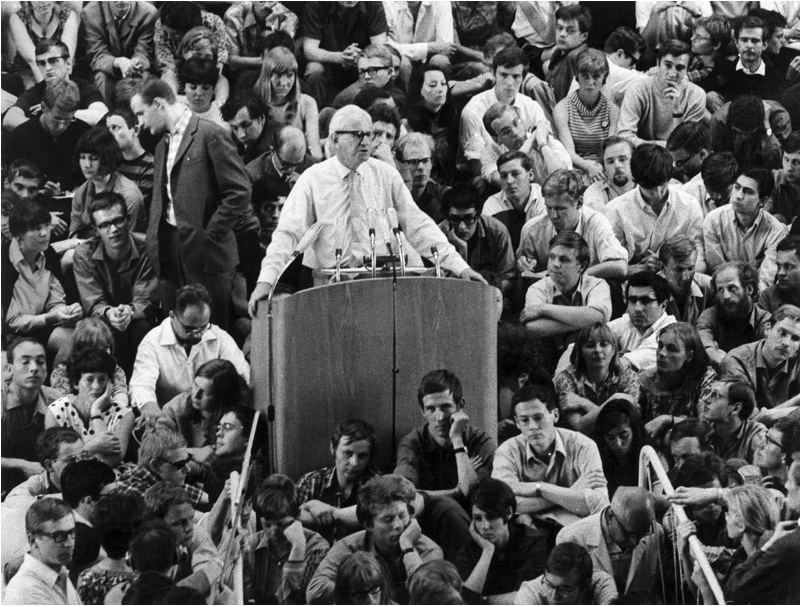
Fall 2014: Phl421 – Herbert Marcuse

MarcuseBerlin1967

General information

Instructor

Here is more information about Prof. Lotz

Class Meetings

Days: TTH
Time: 12:40 PM – 2:00 PM
Place: 210a Berkey Hall

Office

Phone: 517.355.4490 [dept.])
Place: 518 S. Kedzie Hall
Hours: Tu/Th, 5-5:30pm, and by appointment

Other Contact

E-mail: lotz@msu.edu
Home Phone: please ask
Webpage: https://christianlotz.wordpress.com

Box

You will find my box in the front office of the philosophy department (and in front of my office)

Schedule

Introduction

Aug 28, Introduction
Interview with Marcuse (film)

Sep 2, Introduction
Interview with Marcuse (film)

Sep 4, Introduction
Interview with Habermas and others (Telos, via pdf)

The early Marcuse

Sep 9, The Influence of Heidegger
On Concrete Philosophy (pdf)

Sep 11, Marx
New Sources on the Foundation of Historical Materialism (pdf)

Sep 16, Marx
New Sources on the Foundation of Historical Materialism (pdf)

Critical Theory

Sep 18, Critical Theory
Philosophy and critical theory (pdf)

Sep 23, Culture
Philosophy and critical theory (pdf)

Sep 25, Technology
Remarks on a redefinition of culture (pdf)

Sep 30, Technology
Consequences of modern technology (pdf)
Pablo

Oct. 2, Aggression
Aggressiveness in contemporary industrial society (online here)
Recuperating Marcuse against a culture of cruelty (online here)

Eros and Civilization

Oct. 7, Eros and Civilization
Chapter 1.1+1.2
Vlad

Oct 9, Eros and Civilization
Chapter 1.1+1.2
Reaction paper assignment passed out in class

Oct 14, Eros and Civilization
Chapter 1.3+1.4
Nathan

Oct 16, Eros and Civilization
Chapter 1.5
Michael

Oct 21, Eros and Civilization
Chapter 2.6+2.7
Alex

Oct 23, Eros and Civilization
Chapter 2.7+2.9

One Dimensional Man

Oct. 28, One Dimensional Man
Preface+Chapter 1
Guest lecture by Prof. Peterson

Oct. 30, One Dimensional Man
Chapter 2
Maxwell

Nov 4, One Dimensional Man
Chapter 3+4
Josh

Nov 6,
no class

Nov 11, One Dimensional Man
Chapter 3+4
Raffael

Nov 13, One Dimensional Man
Chapter 5+6
Trish

Society, Resistance, and Art

Nov 18, Marxist Aesthetics
The Aesthetic Dimension, chapter 1
Alexander

Nov 20, Marxist Aesthetics
The Aesthetic Dimension, chapter 2
Nick

Nov 21, Special class session
Meeting with Prof. Farr at 9:30am in SK530
Public lecture by Prof. Farr at 3pm

Nov 25,
no class

Nov 27,
Thanksgiving

Wrap Up

Dec 2, Marxist Aesthetics
The Aesthetic Dimension, chapter 3-5
Will

Dec. 4, Wrap up
Documentary film

Dec 11
Final paper due by 12:40 (day of final exam)

Course Description

Given the great experience in my last phl 421 (topic: Hannah Arendt), I decided to teach again a course based on a major “figure” in continental and European philosophy. This time, we will focus on the philosophy of Herbert Marcuse who was a very influential Frankfurt School figure in the 60s and 70s in Europe and the US. His writings are in general very accessible and written without much technicality. Given recent social and economic developments, I believe that it would be worthwhile to look again at Marcuse’s ideas. We will study some of his key texts such as One Dimensional Man and Eros and Civilization, in connection with essays written on society, psychology, Marx, technology, and art. We will listen to two audio lectures by Marcuse and discuss two documentaries on political movements in the 60s. Check out the following web pages for more information: http://plato.stanford.edu/entries/marcuse/ and http://www.marcuse.org/herbert/index.html.

Note

This is a 400-level course in philosophy and, as such, contains difficult material and requires mature students. If you are not willing to study dense written material, listen to unusual lectures, and discuss ideas in an organized fashion, then you should not take this class. This class though can be taken by students without prior knowledge in philosophy. You should not take this class if you are not an avid reader.

Course Goals

This lecture class should students introduce to

  • critical theory
  • the philosophy of Herbert Marcuse
  • the connection between philosophy and society
  • Freud and philosophy
  • philosophical critique of contemporary culture
  • repressive nature of capitalist societies

Note

Students should be aware of the fact that this course is based on difficult texts. Accordingly, this class requires self-responsible learners and an intense confrontation with the primary text. Accordingly, if you are not excited about the prospect of a daily confrontation with abstract and historical reflections, then you should not take this class. This class is not based on a set of fixed knowledge and, as such, is not based on a behavioral idea of education; rather, we will try to learn together and critically examine the material. The instructor of this class does not have anything to teach, but much to learn.

Required Texts (Bookstore)

  • Marcuse, One Dimensional Man
  • Marcuse, Eros and Civilization
  • Marcuse, The Aesthetic Dimension

If you do not want to (or are unable) to purchase these books, then please make copies of the texts/chapters that we will be discussing in class.

There will be additional texts available per pdf.

Course Requirements

  • Daily reading and studying (around 5-10 pages, up to 50 per week)
  • 2 shorter reaction papers
  • 1 thesis statement (short assignment, systematic summary of the readings)
  • 1 final paper
  • brief home work assignments
  • participation

Note

The class and my lectures are solely based on the texts selected for class and require a thorough study and preparation of the material. I will primarily lecture on the readings, which will help you to more fully understand the texts. Therefore it is not sufficient for students to come to class without having prepared the texts. And indeed, in the exams you have to demonstrate whether you have appropriately prepared the readings selected for each lecture.

Note

Every academic misconduct, such as plagiarism, will – without exception – lead to a failing grade in class. Check the Ombudsman’s page (see also note below on plagiarism):  https://www.msu.edu/~ombud/

Assignments

Make-Up Assignments

Students who need to miss assignments for excusable reasons, such as MSU related business, emergency weather conditions, medical emergencies, or death in their families, should – if possible – inform me ahead of time, and will be permitted to make up the exam and movie assignment. I will only accept official doctor notes (no faxes, no emails) or letters from other professors. Unfortunately I am unable to accept any other reasons than those stated above.

Attendance

To get a good grade in this class, regular attendance is required. I will not call roll. Hence, it is up to you to come to class or not. However, if you do not come to class on a regular basis and participate in the class discussion, it is impossible for you to achieve a good grade in this class; so coming to class is your responsibility and your call. If you choose to attend class, please come on time, turn off cell phones and other electronic devices that interfere with your (and others’) concentration, have the reading prepared and be ready to participate. If you are not prepared, do not bother showing up. It is a sign of disrespect to your peers and the instructor to attend class unprepared. If you miss class, it is your responsibility to obtain class notes from a fellow student and to catch up on reading. Nevertheless, please be aware that you should not make me responsible for a failure that results out of your decision. You should be aware that chances to master this class are minimal, if you do not show up for class or if you do not prepare the readings (=studying).

Thesis Statement (brief overview of assigned reading)

Each student has to prepare one thesis paper for class. The thesis paper should contain [a] a list of main points and claims, [b] concepts that are unclear, [c] intelligent questions about the readings. Students who prepare the thesis paper need to send their thesis papers by 8am per email on the due date to me, bring copies for everyone to class and be prepared to briefly present their paper (this will not always happen). The thesis paper is limited to two pages and you must use the following prepared document:

Download thesis paper form

Reaction Paper

Each student has to write two 3-4 page (no more than 1200 words) reaction papers in reaction to one of the readings or YouTube material (depends upon the assignment). The reaction paper should contain a systematic thesis about a selected aspect of the material. Assignments will be passed out in class. Note: you should work with the following online resources (or other resources in the library): Oxford Dictionary of PhilosophyRoutledge Encyclopedia of Philosophy Stanford Encyclopedia of PhilosophyEncyclopedia of Continental Philosophy (e-book) – The Oxford Companion to Philosophy

Final Paper

In order to intensify and improve your understanding of the material, you will turn in one final research and academic style paper, in which you analyze a specific topic (6 pages, double spaced, no more than 1800 words). Assignments will be passed out in class (check schedule).

Unnanounced Assignments

There will be – from time to time – unannounced reading quizzes, weekend homework-assignments, and group assignments. Students who do not attend class (and have no written documentation) will lose all points. Reading quizzes and group assignments cannot be made up, except in emergency cases (see note above).

Class Response Sheets

Every student is asked to submit up to 5 class response sheets during the semester. Please download the form here (plus: print it out five times and add it to your class folder). Response sheets must be submitted at the end of a class session. I do not accept late turn ins or turn ins by email.

Download response sheet (I will only accept answers that are given on this form)

Note

Students are not allowed to turn in response sheets during the last week of class!

Course Evaluation

Assignments

1 final paper (up to 1800 words) 20 points
2 reaction papers (up to 900 words) 20 points
unannounced reading quizzes, weekend home work assignments
and group assignments
25 points
1 thesis statement (use form) 10 points
participation 10 points
response sheets (use form) 15 points
——–
100 points

Grading

4.0 (=A) 100 – 93
3.5 92 – 87
3 (=B) 86 – 82
2.5 81 – 77
2 (=C) 76 – 72
1.5 71 – 65
1.0 (=D) 64 – 60
0.0 < 60

GENERIC SYLLABUS (might not be applicable to each class)

Laptop/Cell Phone Policy

You are not permitted to use laptops and cell phones in class. Please do not text under the table. Cell phones should be removed from tables. Failure to follow this policy will lead to unannounced assignments in class or loss of points (at the digression of the instructor).

Class Attendance

As mentioned above, I do not employ in my classes a class attendance policy. Having said this, you should be aware that class attendance is very important. When engaging in a philosophical and humanistic dialogue it is necessary to be an active and present participant in the ongoing discussion. If you miss class please do not email me asking if you missed anything important. Every class is important. You should get a study buddy for the class; a student in class who will inform you of what you missed. If you miss a class you can come to my office hours or make an appointment to discuss the material, providing you have read the material and you simply want to see if your understanding of the material is on target. Time in office hours will not be used to repeat the class lectures.

Grading Criteria + Paper Writing Tips

Check out this page for grading criteria, example of assignments, etc.

Online Research Sources

Unfortunately, some people think that the internet as such is a reliable source of information. If you decide to use online sources for additional information or your paper then do not just use one of the common internet search engines, such as Google; rather, use reliable academic sources, such as Britannica Online, or the Stanford Encyclopedia of Philosophy. The Internet Ecyclopedia of Philosophy isn’t very good, but still acceptable. Check out MSU’s library resources! And, as with other sources, you must cite any online sources to which you refer in your essay.

Writing Center Information

MSU’s writing center offers excellent help on all matters regarding writing and learning. Check the website at http://writing.msu.edu for an overview and hours. For more information, please call 517.432.3610 or send an e-mail to writing@msu.edu.

Integrity of Scholarship and Grades (Plagiarism)

The following statement of University policy addresses principles and procedures to be used in instances of academic dishonesty, violations of professional standards, and falsification of academic or admission records, herein after referred to as academic misconduct. [See General Student Regulation 1.00, Protection of Scholarship and Grades.]

Academic Honesty

Article 2.3.3 of the Academic Freedom Report states that “The student shares with the faculty the responsibility for maintaining the integrity of scholarship, grades, and professional standards.” In addition, the (insert name of unit offering course) adheres to the policies on academic honesty as specified in General Student Regulations 1.0, Protection of Scholarship and Grades; the all-University Policy on Integrity of Scholarship and Grades; and Ordinance 17.00, Examinations. (See Spartan Life: Student Handbook and Resource Guide and/or the MSU Web site: www.msu.edu) Therefore, unless authorized by your instructor, you are expected to complete all course assignments, including homework, lab work, quizzes, tests and exams, without assistance from any source. You are expected to develop original work for this course; therefore, you may not submit course work completed for another course to satisfy the requirements for this course. Students who violate MSU rules may receive a penalty grade, including but not limited to a failing grade on the assignment or in the course. Contact your instructor if you are unsure about the appropriateness of your course work. (See also https://www.msu.edu/~ombud/)

Plagiarism, from the Ombudsman’s page

Plagiarism (from the Latin plagiarius, an abductor, and plagiare, to steal) is defined by the White House Office of Science and Technology Policy on Misconduct in Research (take that!) as “ . . . the appropriation of another person’s ideas, processes, results or words without giving appropriate credit.”

Accidental or Unintentional
One may not even know that they are plagiarizing.  It is the student’s responsibility to make certain that they understand the difference between quoting and paraphrasing, as well as the proper way to cite material.

Blatant
Here, students are well aware that they are plagiarizing.  Purposefully using someone else’s ideas or work without proper acknowledgment is plagiarism.  This includes turning in borrowed or bought research papers as one’s own.

Self
Turning in the same term paper (or substantially the same paper) for two courses without getting permission from one’s instructor is plagiarism.

Social Media and Sharing of Course Materials

As members of a learning community, students are expected to respect the intellectual property of course instructors. All course materials presented to students are the copyrighted property of the course instructor and are subject to the following conditions of use:

  1. Students may (may not) record lectures or any other classroom activities and use the recordings only for their own course-related purposes.
  2. Students may (may not) share the recordings with other students enrolled in the class. Sharing is limited to using the recordings only for their own course-related purposes.
  3. Students may (may not) not post the recordings or other course materials online or distribute them to anyone not enrolled in the class without the advance written permission of the course instructor and, if applicable, any students whose voice or image is included in the recordings.
  4. Any student violating the conditions described above may face academic disciplinary sanctions.

Accommodations for Students with Disabilities

Students with disabilities should contact the Resource Center for Persons with Disabilities to establish reasonable accommodations. For an appointment with a counselor, call 353-9642 (voice) or 355-1293 (TTY)

Drops and Adds

The last day to add this course is the end of the first week of classes. The last day to drop this course with a 100 percent refund and no grade reported is (see Academic Calendar). The last day to drop this course with no refund and no grade reported is (see Academic Calendar). You should immediately make a copy of your amended schedule to verify you have added or dropped this course.

Note on Attendance

Students who fail to attend the first four class sessions or class by the fifth day of the semester, whichever occurs first, may be dropped from the course.


Spring 2015: Phl 850 – Rationality and its Other II

benjaminGeneral information

Instructors

Here is more information about Prof. LotzHere is more information about Prof. Hedrick

Class Meetings

Days: T
Time: 7 PM – 10 PM
Place: 530 South Kedzie

Office

Phone: 517.355.4490 [dept.])
Place: 518 + 519 S. Kedzie Hall
Hours: by appointment

Other Contact

E-mail: lotz@msu.edu / hedrick@msu.edu
Home Phone: please ask
Webpage: https://christianlotz.wordpress.com

Box

You will find our box in the front office of the philosophy department

Schedule

Introduction

Jan 13, Introduction
Adorno, The Actuality of Philosophy; Adorno, The Idea of Natural History

Philosophy and Experience

Jan 20, Concept and Experience
Adorno, Negative Dialectics, Preface and Introduction (online)

Jan 27, Concept and Experience
Adorno, Negative Dialectics, Preface and Introduction (online)

Feb 3, Concept and Experience
Benjamin, Experience; Experience and Poverty; On the Program of a Coming Philosophy; On the Mimetic Faculty; Doctrine of the Similar; Benjamin, On Language in General;
[protocol: John]

Feb 10, Thought Images
Benjamin, Prologue to The Origin of the German Trauerspiel; Adorno, On Benjamin’s One Way Street, Benjamin, One Way Street, selections (those mentioned by Adorno)
[present.: Chris]

Capitalism as Dream Culture, History

Feb 17,
no class

Feb 24, Dialectical Images
Benjamin, Paris, the Capital of the 19th Century (expose of Arcade Project, 1935 version), Benjamin, Arcade Project, section on theory of knowledge/progress (N); Adorno, Hornberg letter (8/2/1935) and letter to Benjamin on 11/10/1938; voluntary: sections on Marx (X); good background material is available here: Susan Buck-Morss
[present.: Brian]

March 3, Historical Dialectics
Benjamin, On the Concept of History
[protocol.: Michael]

March 10,
Spring Break

March 17, Kracauer

Kracauer, Photography; Kracauer, The mass ornament; Kracauer, Those who wait; Kracauer, On the writings of Benjamin; Kracauer, Cult of distraction; Kracauer, Boredom; Adorno, The Curious Realist
Guest Lecture by Prof. Handelman

March 24, Culture Industry
Adorno/Horkheimer, The Culture Industry
[present. Michael, protocol. Chris]

Social Pathologies, Practical Reason, and Rationality

March 31, Ideology
Habermas, Knowledge and Human Interest, ’The Idea of the Theory of Knowledge as Social Theory’; ’The Scientistic Misunderstanding of Metapsychology’; and ‘Psychoanalysis and Social Theory’.
[present.: Aidan]

Apr 7, Ideology
Habermas, The Hermeneutic Claim to Universality
[present. John]

Apr 14, Ideology
Habermas, Labour and Interaction; Habermas, Science and Technology as Ideology
[protocol Aidan]

Apr 21, Pathologies
Honneth, Love, Rights, and Solidarity; Honneth, Organized Self-Realization; Honneth, On object relations psychoanalysis

Wrap Up

Apr 28, Wrap up

May 4
Final paper due by the end of the day (by email)

Course Description

Unlike approaches to social philosophy in Anglo-American philosophy, where appeals to common sense or moral facts, principles, and intuitions are more routine, in the post-Kantian continental tradition the entanglement of reason with history, society, embodiment, and trauma is a persistent issue. This has dramatically impacted the conceptualizations of critique that emerge from this tradition, making the identification of social obstacles to the development of human potentialities a central undertaking, and complicating the issue of whether and under what conditions philosophy as a critical enterprise is possible in the first place. In this year-long seminar, we will explore several facets of this broad issue in the following modules, which link 19th century critics of rationalism with 20th and 21st century critical theorists: Reason and History; Repression and Embodiment; Dialectics, Experience, and Philosophy; Capitalist Culture and Fetishism; Social Pathologies and Practical Reason.

Note

Although this course is meant to run over two semesters and though the second semester presupposes some topics discussed in the first semester, enrolling in one of the semesters should not present an issue.

Course Goals

This course should students make familiar with critical conceptions of reason and rationality in the German tradition of critical theory, in particular the idea that rationality and irrationality are intertwined and that rationality can only be understood with its “other,” such as repression, dreams, embodiment, social pathologies, and that this entwinement leads to a social-material conception of reason and rationality.

Note

This graduate seminar is not based on a set of fixed knowledge and, as such, is not based on a behavioral idea of education; rather, we will try to learn together and critically examine the material.

Required Texts

TBD in class

Course Requirements

  • Protocol, write-up, up to 900 words, 10%
  • Oral presentation, 20 minutes, 20%
  • Final paper, 10-12 pages, 70%
  • Regular participation, you are expected to not miss any class session

Protocol (German tradition)

The class protocol should cover our discussion in class. Protocols should have a length of 2-3 pages (no more than 900 words), and they will in and outside of the classroom force us to have an ongoing reflection on our texts that we study for class. They can also include problems or questions that the writers had either with our class discussion or with the texts itself, but above all protocols should cover what we lectured about and what we discussed afterwards. Protocols should clarify and discuss selected issues in question. Protocols have to be sent out to other students two days before class. We’ll radically mark down late turn ins. The student who wrote the protocol will address questions during the first 15 minutes of the next class meeting, and he/she will lead the class discussion.

Presentation

Each student will be responsible for one class and for working out an introductory presentation, which should function as a platform for our discussions. Please focus on one or two aspects of the readings; desired length of presentations: no more than 20-25 minutes.

General Remark

Given that this is a graduate seminar, we expect self-motivation, autonomy, as well as self-responsibility. The attendance requires the willingness to intensively study the text selected for class.

Final Paper

The class essay should be well researched and should present a substantial reflection on some parts of the material discussed in class. We expect excellent papers in regard to research, form, and content. We will fail papers that do not comply with formal standards (footnotes, literature, etc.). The paper should be accompanied by an abstract of no more than 150 words. The paper should be “conference style,” i.e., it should have a length of around 12 pages.

DFs

We will refuse giving DFs in this class, unless you find yourself in a real emergency situation (hospitalization, etc.)

Course Evaluation

Assignments

1 final paper (up to 3600 words) 70 points
1 oral presentation 20 points
1 protocol 10 points (pass/fail)
——–
100 points

Grading

4.0 (=A) 100 – 93
3.5 92 – 87
3 (=B) 86 – 82
2.5 81 – 77
2 (=C) 76 – 72
1.5 71 – 65
1.0 (=D) 64 – 60
0.0 < 60

GENERIC SYLLABUS (might not be applicable to each class)

Laptop/Cell Phone Policy

You are not permitted to use laptops and cell phones in class. Please do not text under the table. Cell phones should be removed from tables. Failure to follow this policy will lead to unannounced assignments in class or loss of points (at the digression of the instructor).

Class Attendance

As mentioned above, I do not employ in my classes a class attendance policy. Having said this, you should be aware that class attendance is very important. When engaging in a philosophical and humanistic dialogue it is necessary to be an active and present participant in the ongoing discussion. If you miss class please do not email me asking if you missed anything important. Every class is important. You should get a study buddy for the class; a student in class who will inform you of what you missed. If you miss a class you can come to my office hours or make an appointment to discuss the material, providing you have read the material and you simply want to see if your understanding of the material is on target. Time in office hours will not be used to repeat the class lectures.

Grading Criteria + Paper Writing Tips

Check out this page for grading criteria, example of assignments, etc.

Online Research Sources

Unfortunately, some people think that the internet as such is a reliable source of information. If you decide to use online sources for additional information or your paper then do not just use one of the common internet search engines, such as Google; rather, use reliable academic sources, such as Britannica Online, or the Stanford Encyclopedia of Philosophy. The Internet Ecyclopedia of Philosophy isn’t very good, but still acceptable. Check out MSU’s library resources! And, as with other sources, you must cite any online sources to which you refer in your essay.

Writing Center Information

MSU’s writing center offers excellent help on all matters regarding writing and learning. Check the website at http://writing.msu.edu for an overview and hours. For more information, please call 517.432.3610 or send an e-mail to writing@msu.edu.

Integrity of Scholarship and Grades (Plagiarism)

The following statement of University policy addresses principles and procedures to be used in instances of academic dishonesty, violations of professional standards, and falsification of academic or admission records, herein after referred to as academic misconduct. [See General Student Regulation 1.00, Protection of Scholarship and Grades.]

Academic Honesty

Article 2.3.3 of the Academic Freedom Report states that “The student shares with the faculty the responsibility for maintaining the integrity of scholarship, grades, and professional standards.” In addition, the (insert name of unit offering course) adheres to the policies on academic honesty as specified in General Student Regulations 1.0, Protection of Scholarship and Grades; the all-University Policy on Integrity of Scholarship and Grades; and Ordinance 17.00, Examinations. (See Spartan Life: Student Handbook and Resource Guide and/or the MSU Web site: www.msu.edu) Therefore, unless authorized by your instructor, you are expected to complete all course assignments, including homework, lab work, quizzes, tests and exams, without assistance from any source. You are expected to develop original work for this course; therefore, you may not submit course work completed for another course to satisfy the requirements for this course. Students who violate MSU rules may receive a penalty grade, including but not limited to a failing grade on the assignment or in the course. Contact your instructor if you are unsure about the appropriateness of your course work. (See also https://www.msu.edu/~ombud/)

Plagiarism, from the Ombudsman’s page

Plagiarism (from the Latin plagiarius, an abductor, and plagiare, to steal) is defined by the White House Office of Science and Technology Policy on Misconduct in Research (take that!) as “ . . . the appropriation of another person’s ideas, processes, results or words without giving appropriate credit.”

Accidental or Unintentional
One may not even know that they are plagiarizing.  It is the student’s responsibility to make certain that they understand the difference between quoting and paraphrasing, as well as the proper way to cite material.

Blatant
Here, students are well aware that they are plagiarizing.  Purposefully using someone else’s ideas or work without proper acknowledgment is plagiarism.  This includes turning in borrowed or bought research papers as one’s own.

Self
Turning in the same term paper (or substantially the same paper) for two courses without getting permission from one’s instructor is plagiarism.

Accommodations for Students with Disabilities

Students with disabilities should contact the Resource Center for Persons with Disabilities to establish reasonable accommodations. For an appointment with a counselor, call 353-9642 (voice) or 355-1293 (TTY)

Drops and Adds

The last day to add this course is the end of the first week of classes. The last day to drop this course with a 100 percent refund and no grade reported is (see Academic Calendar). The last day to drop this course with no refund and no grade reported is (see Academic Calendar). You should immediately make a copy of your amended schedule to verify you have added or dropped this course.

Note on Attendance

Students who fail to attend the first four class sessions or class by the fifth day of the semester, whichever occurs first, may be dropped from the course.

Fall 2014: Phl 820 – Rationality and its Other I

frankfurtschool

General information

Instructors

Here is more information about Prof. LotzHere is more information about Prof. Hedrick

Class Meetings

Days: T
Time: 7 PM – 10 PM
Place: 530 South Kedzie

Office

Phone: 517.355.4490 [dept.])
Place: 518 + 519 S. Kedzie Hall
Hours: by appointment

Other Contact

E-mail: lotz@msu.edu / hedrick@msu.edu
Home Phone: please ask
Webpage: https://christianlotz.wordpress.com

Box

You will find our box in the front office of the philosophy department

Schedule

Introduction

Sep 2, Introduction

Suffering, History, and Rationality

Sep 9, Rousseau, Suffering, Society
Rousseau: Discourse on the Origin of Inequality (all); The Social Contract, Book 1, chapters 1, 6-8; Horkheimer, Materialism and Materiality (pdf), pp.103-107 (on empathy); additional brief paragraphs provided in class

Sep 16, Hegel, Reason, and “Reasonable Society”
Hegel: Phenomenology, Preface, paragraphs 1-6, 11-13, 16-18, 20-30, 36, 40, 56-61, 67; Introduction, paragraphs 73-75, 78, 83-84, 88-89; Hegel, Philosophy of Right, preface; Engels, Socialism: Utopian and Scientific, chapter I (online here); Horkheimer, Materialism and Morality (pdf), pp.96-100 and 107-111; selected paragraphs from Marx, Marcuse, and Adorno provided in class
Protocol: Erik

Sep 23, Materialism and Life
Marx, The German Ideology, section one: Feuerbach: Opposition of the Materialist and Idealist Outlooks (online here); Marx, Feuerbach Theses (online here and here)

Sep 30, Instinctual Repression
Freud, Civilization and its Discontent
Presentation: Julia

Oct. 7, Disentchantment
Nietzsche, ‘On the Meaning of Ascetic Ideals’ (selections); Weber, ’Science as Vocation’; Weber, conclusion to The Protestant Ethic.
Presentation: Erik

Oct 14, Abstraction
Horkheimer/Adorno, Dialectic of Enlightenment, Concept of Enlightenment
Protocol: John

Oct 21, Enlightenment
Horkheimer/Adorno, Dialectic of Enlightenment, Odysseus
Protocol: Youjin

Embodiment, Aggression, and Rationality

Oct. 28, Body and Sensuality
Adorno, Negative Dialectics, sections on Primacy of the Object + Materialism (online here; German pages: pp. 184-207); Feuerbach, Feuerbach, Principles of the Philosophy of the Future, part III (online here); Marx, Economic and Philosophic Manuscripts, section on private property and communism (online here); Marx, German Ideology, section on Feuerbach and the production of consciousness (online here)
Protocol: Aidan
Presentation: Brian

Nov 4, Repression, Psychic Economy, Aggression
Freud, The Ego and the Id, section III-V; Freud, Civilization and its Discontent, section VI+VII; Freud, Instincts and their Vicissitudes; Freud, Repression; Adorno, The Revised Psychoanalysis
Presentation: Ahmed
Protocol: Julia

Nov 11, Coldness and Aggression
Adorno, Meditations on metaphysics in ND, first four subsections; Adorno, Minima Moralia (sections 6; 21; 46; 48; 49; appendix VII; online here); Adorno, Education after Auschwitz (pdf); Marcuse; Aggressiveness in Advanced Industrial Societies (online here)
Presentation: Youjin

Nov 18, Sensuality
Marcuse, Eros and Civilization, Political Preface (1966), chapter 1 (The Hidden Trend in Psychoanalysis), and chapters 6 (The Historical Limits of the Established Reality Principle) and 7 (Fantasy and Utopia)
Presentation: John
Protocol: Ahmed

Nov 25, Sensuality
Marcuse, Eros and Civilization, chapter 8 (The Images of Orpheus and Narcissus), 10 (The Transformation of Sexuality into Eros) and 11 (Eros and Thanatos)
Presentation: Aidan

Wrap Up

Dec 2, Wrap up

Dec 8
Final paper due by the end of the day (by email)

Course Description

Unlike approaches to social philosophy in Anglo-American philosophy, where appeals to common sense or moral facts, principles, and intuitions are more routine, in the post-Kantian continental tradition the entanglement of reason with history, society, embodiment, and trauma is a persistent issue. This has dramatically impacted the conceptualizations of critique that emerge from this tradition, making the identification of social obstacles to the development of human potentialities a central undertaking, and complicating the issue of whether and under what conditions philosophy as a critical enterprise is possible in the first place. In this year-long seminar, we will explore several facets of this broad issue in the following modules, which link 19th century critics of rationalism with 20th and 21st century critical theorists: Reason and History; Repression and Embodiment; Dialectics, Experience, and Philosophy; Capitalist Culture and Fetishism; Social Pathologies and Practical Reason.

Note

Although this course is meant to run over two semesters and though the second semester presupposes some topics discussed in the first semester, enrolling in one of the semesters should not present an issue.

Course Goals

This course should students make familiar with critical conceptions of reason and rationality in the German tradition of critical theory, in particular the idea that rationality and irrationality are intertwined and that rationality can only be understood with its “other,” such as repression, dreams, embodiment, social pathologies, and that this entwinement leads to a social-material conception of reason and rationality.

Note

This graduate seminar is not based on a set of fixed knowledge and, as such, is not based on a behavioral idea of education; rather, we will try to learn together and critically examine the material.

Required Texts

To be purchased:

  • Freud, Freud Reader (ed. Gay)
  • Rosseau, Second Discourse
  • Marcuse, Eros and Civilization
  • Adorno/Horkheimer, Dialectic of Enlightenment
  • Nietzsche, Geneology of Morality

Available as pdfs:

  • tbd
  • tbd

Course Requirements

  • Protocol, write-up, up to 900 words, 10%
  • Oral presentation, 20 minutes, 20%
  • Final paper, 10-12 pages, 70%
  • Regular participation, you are expected to not miss any class session

Protocol (German tradition)

The class protocol should cover our discussion in class. Protocols should have a length of 2-3 pages (no more than 900 words), and they will in and outside of the classroom force us to have an ongoing reflection on our texts that we study for class. They can also include problems or questions that the writers had either with our class discussion or with the texts itself, but above all protocols should cover what we lectured about and what we discussed afterwards. Protocols should clarify and discuss selected issues in question. Protocols have to be sent out to other students two days before class. We’ll radically mark down late turn ins. The student who wrote the protocol will address questions during the first 15 minutes of the next class meeting, and he/she will lead the class discussion.

Presentation

Each student will be responsible for one class and for working out an introductory presentation, which should function as a platform for our discussions. Please focus on one or two aspects of the readings; desired length of presentations: no more than 20-25 minutes.

General Remark

Given that this is a graduate seminar, we expect self-motivation, autonomy, as well as self-responsibility. The attendance requires the willingness to intensively study the text selected for class.

Final Paper

The class essay should be well researched and should present a substantial reflection on some parts of the material discussed in class. We expect excellent papers in regard to research, form, and content. We will fail papers that do not comply with formal standards (footnotes, literature, etc.). The paper should be accompanied by an abstract of no more than 150 words. The paper should be “conference style,” i.e., it should have a length of around 12 pages.

DFs

We will refuse giving DFs in this class, unless you find yourself in a real emergency situation (hospitalization, etc.)

Course Evaluation

Assignments

1 final paper (up to 3600 words) 70 points
1 oral presentation 20 points
1 protocol 10 points (pass/fail)
——–
100 points

Grading

4.0 (=A) 100 – 93
3.5 92 – 87
3 (=B) 86 – 82
2.5 81 – 77
2 (=C) 76 – 72
1.5 71 – 65
1.0 (=D) 64 – 60
0.0 < 60

GENERIC SYLLABUS (might not be applicable to each class)

Laptop/Cell Phone Policy

You are not permitted to use laptops and cell phones in class. Please do not text under the table. Cell phones should be removed from tables. Failure to follow this policy will lead to unannounced assignments in class or loss of points (at the digression of the instructor).

Class Attendance

As mentioned above, I do not employ in my classes a class attendance policy. Having said this, you should be aware that class attendance is very important. When engaging in a philosophical and humanistic dialogue it is necessary to be an active and present participant in the ongoing discussion. If you miss class please do not email me asking if you missed anything important. Every class is important. You should get a study buddy for the class; a student in class who will inform you of what you missed. If you miss a class you can come to my office hours or make an appointment to discuss the material, providing you have read the material and you simply want to see if your understanding of the material is on target. Time in office hours will not be used to repeat the class lectures.

Grading Criteria + Paper Writing Tips

Check out this page for grading criteria, example of assignments, etc.

Online Research Sources

Unfortunately, some people think that the internet as such is a reliable source of information. If you decide to use online sources for additional information or your paper then do not just use one of the common internet search engines, such as Google; rather, use reliable academic sources, such as Britannica Online, or the Stanford Encyclopedia of Philosophy. The Internet Ecyclopedia of Philosophy isn’t very good, but still acceptable. Check out MSU’s library resources! And, as with other sources, you must cite any online sources to which you refer in your essay.

Writing Center Information

MSU’s writing center offers excellent help on all matters regarding writing and learning. Check the website at http://writing.msu.edu for an overview and hours. For more information, please call 517.432.3610 or send an e-mail to writing@msu.edu.

Integrity of Scholarship and Grades (Plagiarism)

The following statement of University policy addresses principles and procedures to be used in instances of academic dishonesty, violations of professional standards, and falsification of academic or admission records, herein after referred to as academic misconduct. [See General Student Regulation 1.00, Protection of Scholarship and Grades.]

Academic Honesty

Article 2.3.3 of the Academic Freedom Report states that “The student shares with the faculty the responsibility for maintaining the integrity of scholarship, grades, and professional standards.” In addition, the (insert name of unit offering course) adheres to the policies on academic honesty as specified in General Student Regulations 1.0, Protection of Scholarship and Grades; the all-University Policy on Integrity of Scholarship and Grades; and Ordinance 17.00, Examinations. (See Spartan Life: Student Handbook and Resource Guide and/or the MSU Web site: www.msu.edu) Therefore, unless authorized by your instructor, you are expected to complete all course assignments, including homework, lab work, quizzes, tests and exams, without assistance from any source. You are expected to develop original work for this course; therefore, you may not submit course work completed for another course to satisfy the requirements for this course. Students who violate MSU rules may receive a penalty grade, including but not limited to a failing grade on the assignment or in the course. Contact your instructor if you are unsure about the appropriateness of your course work. (See also https://www.msu.edu/~ombud/)

Plagiarism, from the Ombudsman’s page

Plagiarism (from the Latin plagiarius, an abductor, and plagiare, to steal) is defined by the White House Office of Science and Technology Policy on Misconduct in Research (take that!) as “ . . . the appropriation of another person’s ideas, processes, results or words without giving appropriate credit.”

Accidental or Unintentional
One may not even know that they are plagiarizing.  It is the student’s responsibility to make certain that they understand the difference between quoting and paraphrasing, as well as the proper way to cite material.

Blatant
Here, students are well aware that they are plagiarizing.  Purposefully using someone else’s ideas or work without proper acknowledgment is plagiarism.  This includes turning in borrowed or bought research papers as one’s own.

Self
Turning in the same term paper (or substantially the same paper) for two courses without getting permission from one’s instructor is plagiarism.

Accommodations for Students with Disabilities

Students with disabilities should contact the Resource Center for Persons with Disabilities to establish reasonable accommodations. For an appointment with a counselor, call 353-9642 (voice) or 355-1293 (TTY)

Drops and Adds

The last day to add this course is the end of the first week of classes. The last day to drop this course with a 100 percent refund and no grade reported is (see Academic Calendar). The last day to drop this course with no refund and no grade reported is (see Academic Calendar). You should immediately make a copy of your amended schedule to verify you have added or dropped this course.

Note on Attendance

Students who fail to attend the first four class sessions or class by the fifth day of the semester, whichever occurs first, may be dropped from the course.